

We know about identical twins; most of us have a fascination with people who look exactly the same. We know about fraternal twins– they share the same womb but they only resemble each other as much as normal siblings. But now, we’re learning about a new, extremely rare type of twins: semi-identical.
First, let’s review the science of twins:
Identical twins are effectively clones; one fertilized egg splits into two which then develop in the womb sharing the same placenta. They share the same genome and as a result, are born the same sex. Because of their identical genomes, they are often used in research studies to identify the impact of life experiences on twins. If two people have the same genome, how do they not act completely the same? As researchers have discovered during twin studies, as they experience different life events, their behavior and even their DNA diverge. Identical twins give us a unique opportunity to study whether nature (DNA) or nurture (life experience) is a larger influence on personality traits and health outcomes. Unfortunately, though, identical twins are relatively rare; they occur in only 4 of every 1,000 births and occur completely randomly (they don’t run in families).
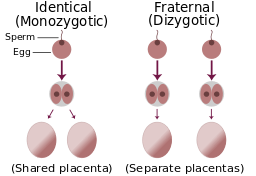 Fraternal twins, though, are a different story. They are much more common with about 22.8 in every 1,000 births. Furthermore, they develop from two separate eggs, each fertilized by different sperm. These twins have their own placentas. Unlike identical twins, fraternal twins run in the family; mothers may have genes or hormone levels that raise the likelihood that they will have fraternal twins.
So what are semi-identical twins and how do they fit in the picture?
In a recent article in the NYTimes, Dr. Nicholas M. Fisk described the first case of semi-identical twins that were discovered during pregnancy and the second recorded case of semi-identical twins ever. Looking at the ultrasound in his practice in Australia, he saw a girl and a boy who shared the same placenta (they are now healthy 4-year-olds). This was surprising because twins that share the same placenta are supposed to be identical twins who cannot be of different sexes. After genome sequencing of both children, they discovered that they are actually only 75% identical.
So, how does the science work? Well, each child received the same genetic information from their mother, meaning that they come from the same egg. However, they have different genetic information from their father, meaning that they probably come from different sperm. These two sperm had different sex chromosomes, giving one child an X, making it a girl, and one child a Y, making it a boy.
But here’s the problem: only one sperm is supposed to be able to fertilize an egg. Once an egg is fertilized, the membrane of the egg prevents other sperm from entering.
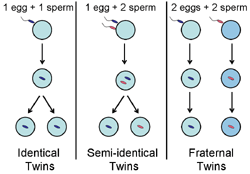 Scientists now believe that this was a case where that didn’t happen. They think that two sperm somehow fertilized the same egg, the egg splitting in the process. This is incredibly rare, with one other case reported in Australia. However, it is a fascinating discovery and deserves more research. Knowing the mechanisms of how these semi-identical twins occur would tell us more about the fertilization process in general: what exactly happens when the first sperm enters an egg? It will also be fascinating to learn about the effect of nurture on twins who are 75% identical.

 Science On Tap
It’s actually a nice and helpful piece of info.
I am happy that you just shared this useful information with us.
Please keep us up to date like this. Thanks for sharing.
LikeLike